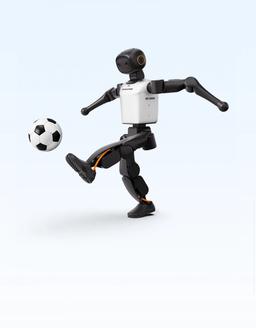

What Is the RoboCup Humanoid League?
RoboCup is an international robotics tournament held since the late 1990s; the Humanoid League is the league where fully autonomous, two-legged robots with human-like bodies play football. There is no human intervention during a match: the robot finds the ball, goals, field and opponents with its own perception, and reads referee decisions from the GameController packets broadcast by the referee computer on the field.
For years the league was played in KidSize and AdultSize categories by robot height. In Booster's 9 July 2026 announcement the 2026 categories are called Small, Middle and Large. Category limits, team size and communication rules are updated every year; the binding document is that year's official rule set.
For a Turkish-language background read, see TÜBİTAK Bilim Teknik's article on humanoid robot sports.
What Should a Humanoid Football Robot Have?
- Falling and getting up: In a match the robot falls, collides and has to get up by itself. The body must withstand impacts and the software needs a reliable get-up motion. The Booster SDK has GetUp and LieDown commands and a separate data channel for fall state (rt/fall_down).
- Vision: The ball, goalposts, field lines and opposing robots must be detected from the camera and placed in the robot's coordinate frame. That takes on-board compute for inference: 48 to 200 TOPS by edition on the K1.
- Torque and agility: Kicks, quick turns and shoulder-to-shoulder duels depend on joint torque. The K1 has 60 N·m (manufacturer-stated) peak torque; for the K1's 19.5 kg body that ratio is high.
- Battery: The robot should finish a half on one battery; spare packs and a quick-swap plan are part of team logistics. The K1 Education and Professional offer about 70 minutes at a 1.1 m/s walk, the Geek about 20 minutes.
- Open software: Writing the perception, decision and referee-controller layers from scratch can consume a team's first year. A ready, open-source match stack saves a great deal of time.
Results and Official Sources
Tournament results, category names and team lists change every year. For current and binding information, consult RoboCup's own publications and that year's official rule set; this guide makes no claim about results or rankings.
Which robot should you choose for robot football?
It depends on the category. For RoboCup's small and middle-size categories, the Booster K1 is a sensible starting point. For a university team in its first year, the K1 means a lower budget, easier transport and a faster iteration loop. Teams aiming at the large-size category need a separate platform assessment against the current rule set.
How many robots does a robot football team need?
The number of players on the field changes by category and year, so rather than give a fixed number we suggest checking the current rule set. As a pointer, Booster's robocup_demo repository states that 5-versus-5 game support was added for the 2026 rule update. On top of the field players, planning at least one spare robot, a spare battery for each robot and a separate body for testing keeps a broken robot from leaving the team short during tournament week.
Building a Team from Turkey: Hardware, Software and Budget Items
- Robots: field players, a spare robot and a development body.
- Power: a spare battery per robot and charging infrastructure.
- Development computer: an NVIDIA GPU workstation for vision model and reinforcement learning training (see the Booster Gym guide).
- Practice area: part of a field, a goal and a ball; data collection to retrain the vision model under your own lighting.
- Training and support: SDK, ROS 2 and robocup_demo setup, team training, spare parts.
- Tournament logistics: transport cases, travel and registration.
For the quote structure on the robot side see the K1 pricing page.
Robotlar.org is the official Booster Robotics distributor in Turkey. The K1 is invoiced in Turkey; a proforma including taxes and freight, on-site commissioning, SDK and robocup_demo setup training, a 1-year warranty and authorized service are delivered in Turkey. We support university purchases with specifications and the research-fund (BAP) process; ordering steps are in the Booster buying guide.
Alternative Platforms
Football demos and biped locomotion research can be done on other bodies too. The Unitree G1 and R1 are two frequently asked options; we put the R1 next to the K1 in our Booster K1 and Unitree R1 comparison.
When choosing a platform, factor this in: Booster publishes its match software as open source; a team starting on another body may have to build most of the perception, decision and referee-controller layers itself.